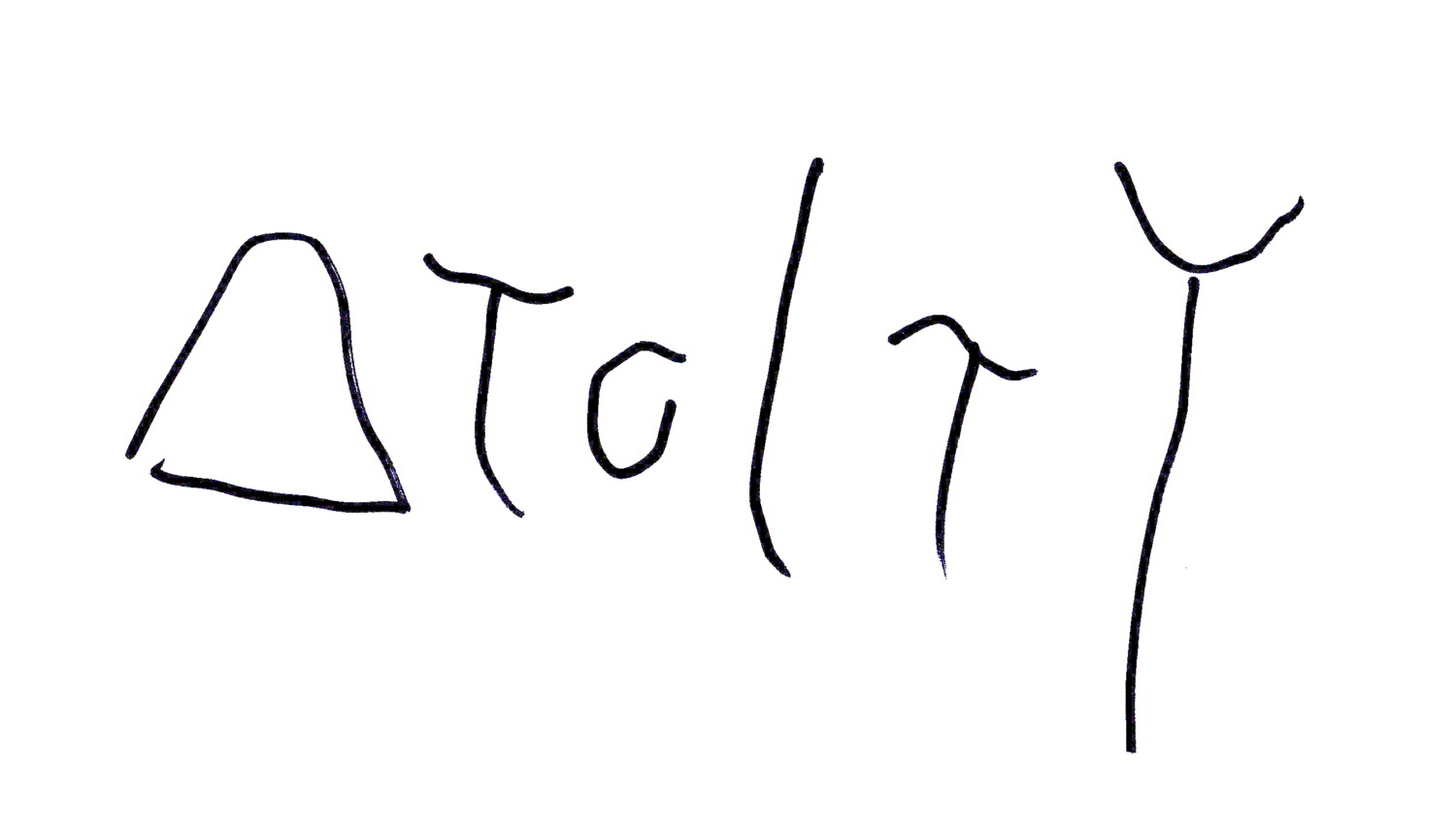

me, Atolty. Pronounced as: uh-TAHL-tee
THE SHAPED DESIRES OF ATOLTY
(Atolty is pronounced as: uh-TAHL-tee)
The artist ATOLTY creates his own visual language of signs and scratches, usually made on discarded and damaged old oil paintings by unknown artists but also on other found or discarded material. He was inspired by the cave drawings on Curaçao, the island where he spent his whole childhood.
Everything Atolty creates begins with a fascination for things he encounters: ancient cave drawings, shells from the bottom of the ocean, pieces of chewed gum, incomplete puzzles, scraps of text from his own failed ideas, or leftover material from a pencil sharpener, the only thing remaining from the drawing he wanted to make. These are the starting points for ideas that ultimately find new forms in paint, ink, cardboard, canvas, and whatever else is at hand. Atolty wants to give shape to desires and explores the liberating space between communicating and concealing, between silence and words, between realism and abstraction, and between the flat and the sculptural.
The name Atolty refers to the loving ending of the letters his father sent home: 'Across The Oceans Love To You'. It is also the pseudonym of Rupert van Woerkom (1950). Atolty spent his childhood on the island of Curaçao, where he painted and drew from an early age. Later, in the Netherlands, he had an award-winning career in the world of media and communication, but remained the artist he had always been. Because of the intertwining of his own name with that of the magazine world, he chose the pseudonym Atolty. The island of Curaçao plays an important role in all his work. The marks and scratches and the asemetic script on the seemingly monochrome minimalist canvases form a visual language that he developed himself.
Atolty expresses what he sees in sometimes melancholic, sometimes light-hearted, and always warm feelings. For example, by discovering the infinite shades of color between black and white or by bringing together the brown tones of the earth and the blue of the sea. He makes intuitive connections between us and what people sometimes left behind thousands of years ago or recently, and the new expressions of modern artists. In doing so, he gives the viewer just enough ingredients to add beauty themselves and make their own associations. Although his style is very distinctive, he is considered a post-minimalist.
mission statement
The triumph of failure
by
ATOLTY
I call my artworks the triumph of failure.
I work exclusively with what has been left behind:
discarded paintings, fragments, remnants, traces of use, failed attempts.
I do not restore. I do not interpret. I do not improve.
I create a second life.
What failed as an image remains useful to me as an inspiring starting point.
What lost its coherence is given a new structure. All of this imposes itself.
What has been discarded is painted over.
Deviations arise exclusively from the material itself.
The new work deserves a second life.
I could never have created my artworks without the 'help' of failed and discarded canvases or other materials.
I therefore call the new work ‘the triumph of failure’.
Atolty
(pronounce: uh-TAHL-tee)